
Door hinge polishing machine selection starts with the final surface requirement, not the catalog rating. Steel and zinc die cast hinges respond differently to batch finishing, and a line that only chases throughput often creates uneven edge rounding, media trapped in knuckle gaps, or plating rejects. We work backward from a uniform pre-plate satin finish with all sharp edges broken and no embedded abrasive. Once material, surface specification, and monthly volume are fixed, the machine type, media, and compound choices become clear. That sequence reduces rework more than any single equipment feature.
How Does a Door Hinge Polishing Machine Replace Hand Deburring?
Hand deburring hinges is slow and hard to repeat. Operators work around knuckles, screw holes, and stamping breakouts, so edge pressure changes from part to part. A door hinge polishing machine applies the same loose media action across the full batch. The bowl moves media and parts together, and exposed edges receive continuous low-impact contact. This breaks sharp corners, removes burrs, and blends surface texture without relying on operator angle or pressure.
For hinges, the useful action is not aggressive grinding. It is controlled edge rounding and uniform surface preparation. Steel stampings with light burrs run well in vibratory equipment. Zinc die cast hinges need a gentler motion because the material is softer and more likely to show impact marks. The same principle applies to stamped brass face plates: cutting action should be matched to the softest component in the batch.
Which Finishing Machine Types Suit Door Hinge Production?
Different machine types create different contact energy and flow patterns. The table below matches common hinge requirements to equipment.
| Machine type | Best hinge application | Process character | Finish result |
|---|---|---|---|
| Vibratory bowl | Stamped steel hinges, mixed hardware, high volume | Loose mass, low to medium energy | Satin, deburr, radius |
| Vibratory bowl with separation | Long runs with direct labor reduction | Same as vibratory plus automatic media separation | Consistent pre-plate finish |
| Centrifugal disc | Smaller steel and zinc hinges, faster edge break | High energy, tight circular flow | Bright satin, shorter cycle |
| Centrifugal barrel | Compact hinge components, hard burrs | Very high G force, contained barrels | Aggressive deburr, uniform surface |
| Dry barrel polisher | Clean hardware after wet processing | Dry media, gentle sliding | Dry brightening, no drying step |
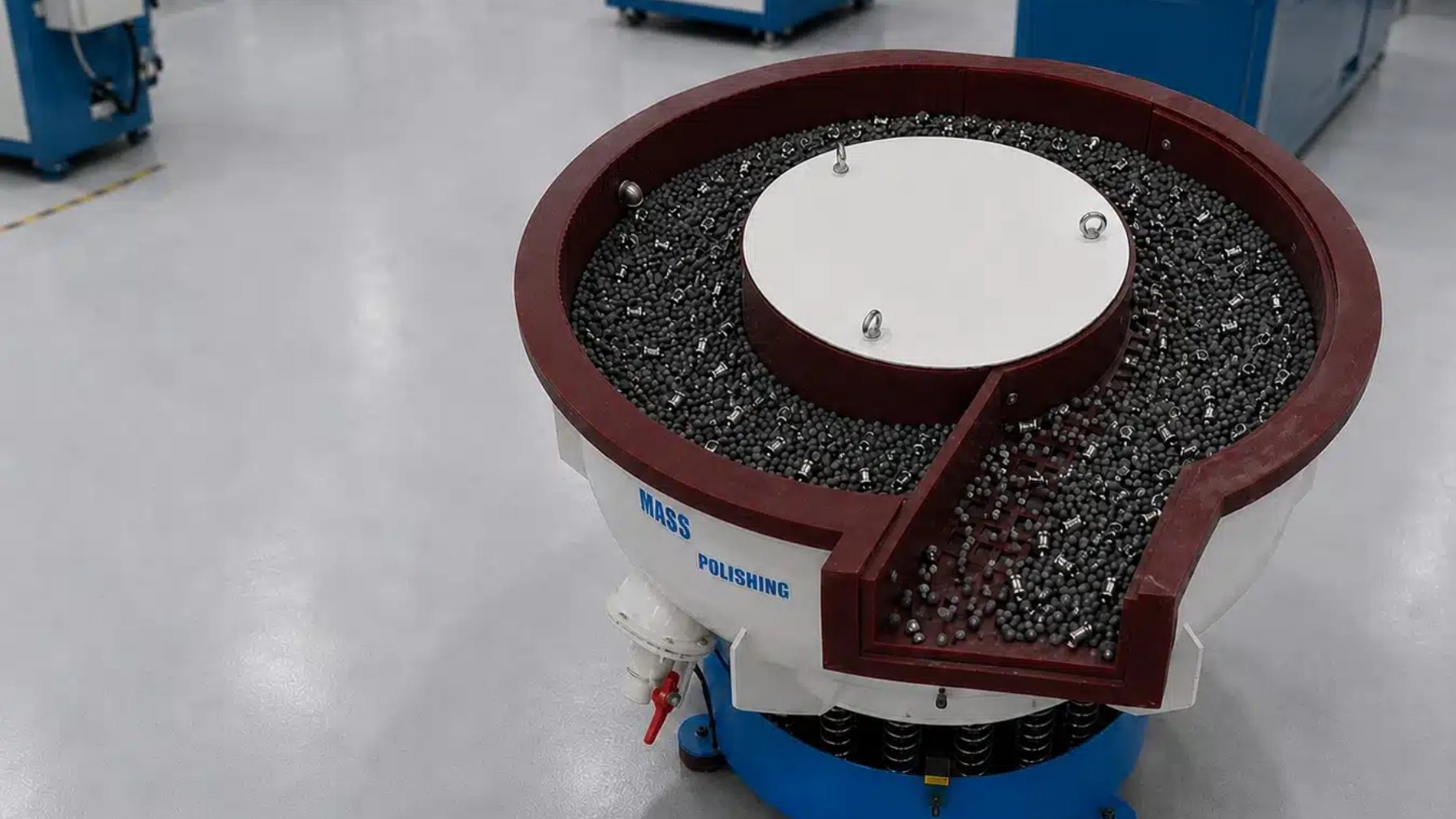
For most hardware plants, the straight wall or curved wall vibratory bowl is the starting point. Models such as the SW 150 or CW 150 offer 150 liter capacity with cast polyurethane lining and enough bowl depth for hinge plates and knuckle assemblies. When manual separation takes too much labor, a CWS model with a built-in separation system gives the same finishing action and moves media separation from manual work to automatic discharge.
Centrifugal disc equipment earns its floor space when cycle time matters. The ED series delivers ten to fifteen times greater force than conventional vibratory systems, which is why it clears stamping burrs and breaks edges faster on steel and zinc hinges. For compact components with hard burrs, centrifugal barrel machines generate high G forces inside separate barrels and can produce an isotropic surface finish before plating.
For hinge lines with short cycle targets and hard burrs, <Centrifugal Barrel Deburring Machines High Efficiency Mass Finishing Solutions> covers how high energy barrel finishing cuts process time on compact steel and zinc components.
If your program mixes stamped stainless and cast zinc hinges, do not average the load recipe. The zinc components control the media choice and cycle time. If the specification requires a bright nickel chrome finish, it is worth confirming the zinc alloy grade and plating line chemistry before you lock equipment size. Send those details to [email protected] and we can flag whether one machine cell or two separate cells makes more sense.
Automation payback depends less on machine price and more on labor hours returned and plating rejects avoided. A line that now uses one operator per shift for hand edge breaking and still sees occasional lodgement or plating failures usually has a straightforward case. Media wear and compound consumption belong in the same calculation because zinc pre-plate media wears faster than ceramic. We build the estimate from a test run on real hinges instead of catalog cycle times.
Machine – Precision Deburring)
What Media and Compound Pairings Deliver a Plating Grade Finish?
Media selection matters more than machine horsepower for door hardware. Steel hinges need a ceramic media with enough cut to remove stamping burrs but not so aggressive that it tears the surface. A general or light cut ceramic shape from the MC or LC range works well, paired with a liquid polishing compound such as HM2. Zinc die cast hinges call for plastic pre-plate media with a finer abrasive grit, because ceramic can lodge in softer surfaces and disturb the plating layer.
For brass hinges that will be lacquered, the sequence often runs from plastic pre-plate media to a fine porcelain or walnut shell dry step. The goal is a clean, uniform surface with no residual compound film. Stainless steel hinges that need a true mirror finish usually require a second step with high density stainless steel or zirconia media.
For steel and stainless hardware, media density and surface hardness change the final brightness more than cycle time alone. <Stainless Steel Walnut Zirconic Finishing Media> covers how steel, walnut, and zirconic media each affect deburring and polish.
Why do zinc hinges need a different media than steel hinges?
Zinc is softer and less dense than steel. Ceramic media that cuts a steel stamping can leave scratches or embedded particles in zinc. Plastic media with a 600 to 800 grit abrasive range cuts lightly and bends around detail, so it removes die cast flash without compromising the surface the plating line will receive. Keeping separate loads for steel and zinc avoids cross contamination and media lodging.
What surface roughness should a hinge reach before plating?
Most bright nickel chrome and satin nickel specifications require a visually uniform surface free of burrs, pits, and embedded media. Many lines work with an Ra of 1.6 micrometers or finer, but the binding limit is the plating control plan. If the hinge is powder coated instead of plated, a rougher clean profile may be acceptable. Confirm the exact Ra or visual standard before setting a cycle; that number determines whether a vibratory bowl is enough or a higher energy disc step is required.
How Do You Lock a Repeatable Door Hinge Finishing Process?
The difference between a stable hinge line and a rework generator is documentation. Each load needs the same part count, media level, water or compound dose, and cycle time. When any of those drift, the finish changes. We treat the first production run as a qualification test, not a demonstration.
- Sort hinge families by material and end finish. Steel, brass, and zinc cannot share one recipe.
- Set measurable acceptance criteria for edge break, surface texture, and lodged media.
- Run a small batch trial on the selected machine with the intended media and compound.
- Record load weight, media volume, compound flow, water flow, and cycle time for the acceptable result.
- Separate and dry the parts, then inspect a fixed sample under magnification.
- Lock the process card and train operators to follow it without incremental changes.
Process qualification also exposes geometry problems. Hinge knuckle gaps smaller than the media diameter can trap particles. In those cases, we specify a divider, a larger media shape, or a barrel process that limits loosened flow. The machine selection can only be final after a real part family has run through the full sequence.
A stable vibratory process depends on bowl geometry, media movement, and loading. <How [Vibratory Finishing](https://www.masspolishing.com/products-vibratory-finishing-machines) Machine Works> explains the mechanical action that determines where and how fast edge rounding occurs.
How long does a steel hinge deburring cycle run?
It depends on burr thickness and finish target. A light stamping burr on a carbon steel hinge plate often clears in 20 to 40 minutes in a vibratory bowl with medium cut ceramic media. Zinc die cast flash usually needs 10 to 20 minutes with pre-plate plastic media. These are starting points, not fixed promises, because bowl diameter, media fill level, and compound concentration all shift the result. A short qualification run gives the production cycle time.
How Do You Specify a Door Hinge Polishing Machine for Your Plant?
A hinge finishing line fails when the machine is specified before the part is tested. If your parts carry mixed materials, tight knuckle gaps, or a demanding plating specification, a catalog rating cannot answer the only question that matters: what will this process do to your actual hinge?
We test hinges in our finishing lab, then recommend the machine, media, compound, and cycle that match the required edge break and surface finish. Send your part number, material, blanking method, target finish, and monthly quantity to [email protected], or call the Mass Polishing office at +86 572 220 8888 to confirm sample processing lead time.
What Door Hinge Finishing Questions Do Buyers Ask?
Can one machine handle both steel and zinc hinges?
Yes, but not in the same load recipe. Steel hinges tolerate ceramic media and a higher energy cycle; zinc hinges need plastic pre-plate media and shorter time. Running both materials in one bowl with one recipe usually damages the zinc or leaves steel edges too sharp. Most plants either separate the part families by shift or install two smaller cells instead of one large mixed load.
Will mass finishing round over hinge edges too much?
A common worry is that vibratory finishing will destroy crisp edges. In practice, edge rounding is measurable and controllable. A light cut plastic media with a short cycle radiuses sharp corners without changing the hinge silhouette. If the drawing permits only a small edge break, the process card needs an explicit radius target, and a longer cycle should not replace a smaller, less aggressive media.
How do you keep media from lodging in hinge knuckles?
It depends on the gap between the knuckle and pin. When the opening is small, use media whose diameter cannot enter the gap, or add a divider system for large components. For very tight knuckle clearances, a centrifugal disc or drag style process with controlled part orientation works better than a free tumbling bowl. A test run with a few hundred pieces will show whether lodgement risk is real.
Is a vibratory bowl enough for a pre-plating finish?
For stamped steel hinges with a satin nickel or powder coat target, yes. The bowl can deburr, radius, and clean in one cycle. For zinc die cast hinges with bright nickel chrome, a vibratory bowl still works, but the recipe must use pre-plate plastic media and a short cycle. If the specification calls for mirror polish, the vibratory bowl is only the first step; a centrifugal disc or drag process follows.
What should I send for a sample process test?
Send the part number, material grade, blanking or casting process, plating specification, and monthly quantity. Include a few rejected parts if plating adhesion or edge condition is the current problem. We run a small batch, document the recipe, and return the samples with the process recommendation. Share the same details with [email protected] and we will confirm whether a door hinge polishing machine test is the fastest next step.
If you’re interested, check out these related articles:
How to Realize High Efficiency Grinding with Three Dimensional Vibratory Finishing Machine
How to Use Barrel Polishing Machine