
Door hinge polishing machine selection starts with the final surface requirement, not the catalog rating. Steel and zinc die cast hinges respond differently to batch finishing, and a line that only chases throughput often creates uneven edge rounding, media trapped in knuckle gaps, or plating rejects. We work backward from a uniform pre-plate satin finish with all sharp edges broken and no embedded abrasive. Once material, surface specification, and monthly volume are fixed, the machine type, media, and compound choices become clear. That sequence reduces rework more than any single equipment feature.
How Does a Door Hinge Polishing Machine Replace Hand Deburring?
Hand deburring hinges is slow and hard to repeat. Operators work around knuckles, screw holes, and stamping breakouts, so edge pressure changes from part to part. A door hinge polishing machine applies the same loose media action across the full batch. The bowl moves media and parts together, and exposed edges receive continuous low-impact contact. This breaks sharp corners, removes burrs, and blends surface texture without relying on operator angle or pressure.
For hinges, the useful action is not aggressive grinding. It is controlled edge rounding and uniform surface preparation. Steel stampings with light burrs run well in vibratory equipment. Zinc die cast hinges need a gentler motion because the material is softer and more likely to show impact marks. The same principle applies to stamped brass face plates: cutting action should be matched to the softest component in the batch.
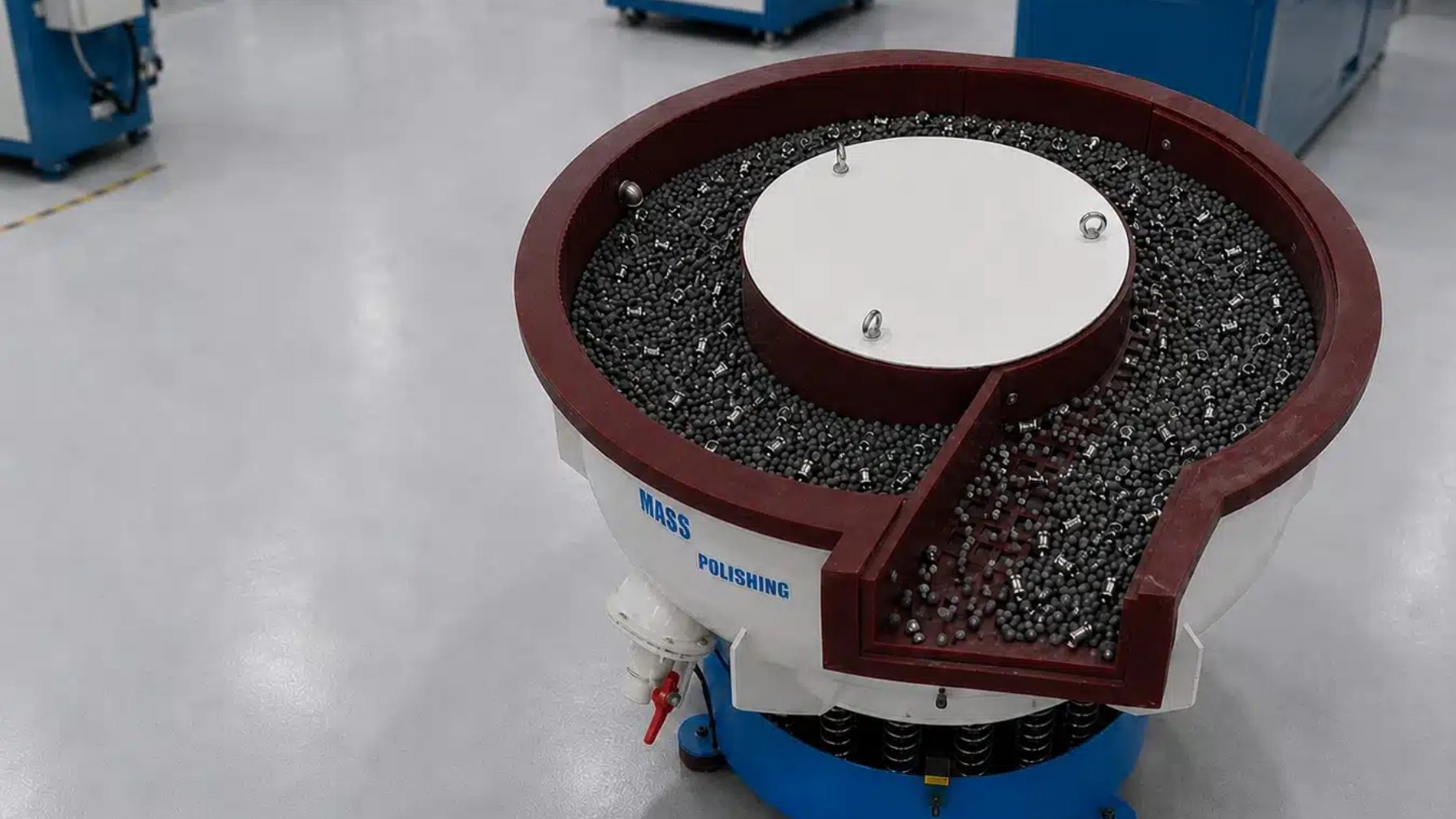
Which Finishing Machine Types Suit Door Hinge Production?
Different machine types create different contact energy and flow patterns. The table below matches common hinge requirements to equipment.
| Tipo de máquina | Best hinge application | Process character | Finish result |
|---|---|---|---|
| Cuba vibratoria | Stamped steel hinges, mixed hardware, high volume | Loose mass, low to medium energy | Satin, deburr, radius |
| Vibratory bowl with separation | Long runs with direct labor reduction | Same as vibratory plus automatic media separation | Consistent pre-plate finish |
| Disco centrífugo | Smaller steel and zinc hinges, faster edge break | High energy, tight circular flow | Bright satin, shorter cycle |
| Cilindro centrífugo | Compact hinge components, hard burrs | Very high G force, contained barrels | Aggressive deburr, uniform surface |
| Dry barrel polisher | Clean hardware after wet processing | Dry media, gentle sliding | Dry brightening, no drying step |
For most hardware plants, the straight wall or curved wall vibratory bowl is the starting point. Models such as the SW 150 or CW 150 offer 150 liter capacity with cast polyurethane lining and enough bowl depth for hinge plates and knuckle assemblies. When manual separation takes too much labor, a CWS model with a built-in separation system gives the same finishing action and moves media separation from manual work to automatic discharge.
Centrifugal disc equipment earns its floor space when cycle time matters. The ED series delivers ten to fifteen times greater force than conventional vibratory systems, which is why it clears stamping burrs and breaks edges faster on steel and zinc hinges. For compact components with hard burrs, centrifugal barrel machines generate high G forces inside separate barrels and can produce an isotropic surface finish before plating.
For hinge lines with short cycle targets and hard burrs, <Máquinas de desbarbado por centrifugado de barril de alta eficiencia Soluciones de acabado en masa> covers how high energy barrel finishing cuts process time on compact steel and zinc components.
If your program mixes stamped stainless and cast zinc hinges, do not average the load recipe. The zinc components control the media choice and cycle time. If the specification requires a bright nickel chrome finish, it is worth confirming the zinc alloy grade and plating line chemistry before you lock equipment size. Send those details to [email protected] and we can flag whether one machine cell or two separate cells makes more sense.
Automation payback depends less on machine price and more on labor hours returned and plating rejects avoided. A line that now uses one operator per shift for hand edge breaking and still sees occasional lodgement or plating failures usually has a straightforward case. Media wear and compound consumption belong in the same calculation because zinc pre-plate media wears faster than ceramic. We build the estimate from a test run on real hinges instead of catalog cycle times.
Máquina – Desbarbado de Precisión)
What Media and Compound Pairings Deliver a Plating Grade Finish?
Media selection matters more than machine horsepower for door hardware. Steel hinges need a ceramic media with enough cut to remove stamping burrs but not so aggressive that it tears the surface. A general or light cut ceramic shape from the MC or LC range works well, paired with a liquid polishing compound such as HM2. Zinc die cast hinges call for plastic pre-plate media with a finer abrasive grit, because ceramic can lodge in softer surfaces and disturb the plating layer.
For brass hinges that will be lacquered, the sequence often runs from plastic pre-plate media to a fine porcelain or walnut shell dry step. The goal is a clean, uniform surface with no residual compound film. Stainless steel hinges that need a true mirror finish usually require a second step with high density stainless steel or zirconia media.
For steel and stainless hardware, media density and surface hardness change the final brightness more than cycle time alone. <Stainless Steel Walnut Zirconic Finishing MediacURL Too many subrequests by single Worker invocation. To configure this limit, refer to https://developers.cloudflare.com/workers/wrangler/configuration/#limits.
cURL Too many subrequests by single Worker invocation. To configure this limit, refer to https://developers.cloudflare.com/workers/wrangler/configuration/#limits
cURL Too many subrequests by single Worker invocation. To configure this limit, refer to https://developers.cloudflare.com/workers/wrangler/configuration/#limits.
- cURL Too many subrequests by single Worker invocation. To configure this limit, refer to https://developers.cloudflare.com/workers/wrangler/configuration/#limits.
- cURL Too many subrequests by single Worker invocation. To configure this limit, refer to https://developers.cloudflare.com/workers/wrangler/configuration/#limits.
- cURL Too many subrequests by single Worker invocation. To configure this limit, refer to https://developers.cloudflare.com/workers/wrangler/configuration/#limits.
- cURL Too many subrequests by single Worker invocation. To configure this limit, refer to https://developers.cloudflare.com/workers/wrangler/configuration/#limits.
- cURL Too many subrequests by single Worker invocation. To configure this limit, refer to https://developers.cloudflare.com/workers/wrangler/configuration/#limits.
- cURL Too many subrequests by single Worker invocation. To configure this limit, refer to https://developers.cloudflare.com/workers/wrangler/configuration/#limits.
cURL Too many subrequests by single Worker invocation. To configure this limit, refer to https://developers.cloudflare.com/workers/wrangler/configuration/#limits.
cURL Too many subrequests by single Worker invocation. To configure this limit, refer to https://developers.cloudflare.com/workers/wrangler/configuration/#limitscURL Too many subrequests by single Worker invocation. To configure this limit, refer to https://developers.cloudflare.com/workers/wrangler/configuration/#limitscURL Too many subrequests by single Worker invocation. To configure this limit, refer to https://developers.cloudflare.com/workers/wrangler/configuration/#limits.
cURL Too many subrequests by single Worker invocation. To configure this limit, refer to https://developers.cloudflare.com/workers/wrangler/configuration/#limits
cURL Too many subrequests by single Worker invocation. To configure this limit, refer to https://developers.cloudflare.com/workers/wrangler/configuration/#limits.
cURL Too many subrequests by single Worker invocation. To configure this limit, refer to https://developers.cloudflare.com/workers/wrangler/configuration/#limits
cURL Too many subrequests by single Worker invocation. To configure this limit, refer to https://developers.cloudflare.com/workers/wrangler/configuration/#limits
cURL Too many subrequests by single Worker invocation. To configure this limit, refer to https://developers.cloudflare.com/workers/wrangler/configuration/#limits.
cURL Too many subrequests by single Worker invocation. To configure this limit, refer to https://developers.cloudflare.com/workers/wrangler/configuration/#limits
cURL Too many subrequests by single Worker invocation. To configure this limit, refer to https://developers.cloudflare.com/workers/wrangler/configuration/#limits
cURL Too many subrequests by single Worker invocation. To configure this limit, refer to https://developers.cloudflare.com/workers/wrangler/configuration/#limits.
cURL Too many subrequests by single Worker invocation. To configure this limit, refer to https://developers.cloudflare.com/workers/wrangler/configuration/#limits
cURL Too many subrequests by single Worker invocation. To configure this limit, refer to https://developers.cloudflare.com/workers/wrangler/configuration/#limits.
Si está interesado, consulte estos artículos relacionados:
cURL Too many subrequests by single Worker invocation. To configure this limit, refer to https://developers.cloudflare.com/workers/wrangler/configuration/#limits
cURL Too many subrequests by single Worker invocation. To configure this limit, refer to https://developers.cloudflare.com/workers/wrangler/configuration/#limits