
Watch band polishing for mass production usually fails on consistency, not on basic brightness. A batch can look acceptable under shop lighting and still show dull inner links, softer edge rounding on one side, or surface variation after electroplating. We see this pattern when manufacturers treat watch bands like ordinary metal parts and run them through a general-purpose vibratory recipe. At Mass Polishing, we start from the opposite direction: the link geometry, alloy, and final plating requirement set the media, machine, and control limits. This article explains how to hold that finish across every load, not just in a sample run.
Link Geometry and Alloy Requirements in Watch Band Polishing
Watch band polishing is not a single-surface problem. A stainless steel bracelet may combine folded links, solid end links, spring bar holes, and a clasp, each with a different contact profile in the machine. In a vibratory bowl, those differences become selective finishing: outer surfaces receive more media contact, while inner link faces and recesses receive less. The result is not uniform brightness but a pattern of overworked edges and underworked pockets.
The first step is to classify the band by where part-on-part contact is acceptable. Solid bracelets can tolerate more aggressive loading if the media is small enough to enter the gaps. Hollow or thin-wall links require lower energy, smaller media, and often anti-adhesion beads to keep nested parts from locking together.
Alloy choice changes the watch band polishing route. 316L stainless steel cuts slowly and needs ceramic media with higher cutting action when edge rounding and deburring must happen in the same step. Titanium bands are more sensitive to surface tearing and galling, so a gentler media shape and a lubricating compound usually perform better. Link design also determines whether you can process the band fully assembled or whether links must be finished before assembly. We prefer finishing links before assembly when the clasp or spring bar area would trap media or compound; it avoids extra manual cleaning after the machine.
Media Selection for Consistent Watch Band Polishing
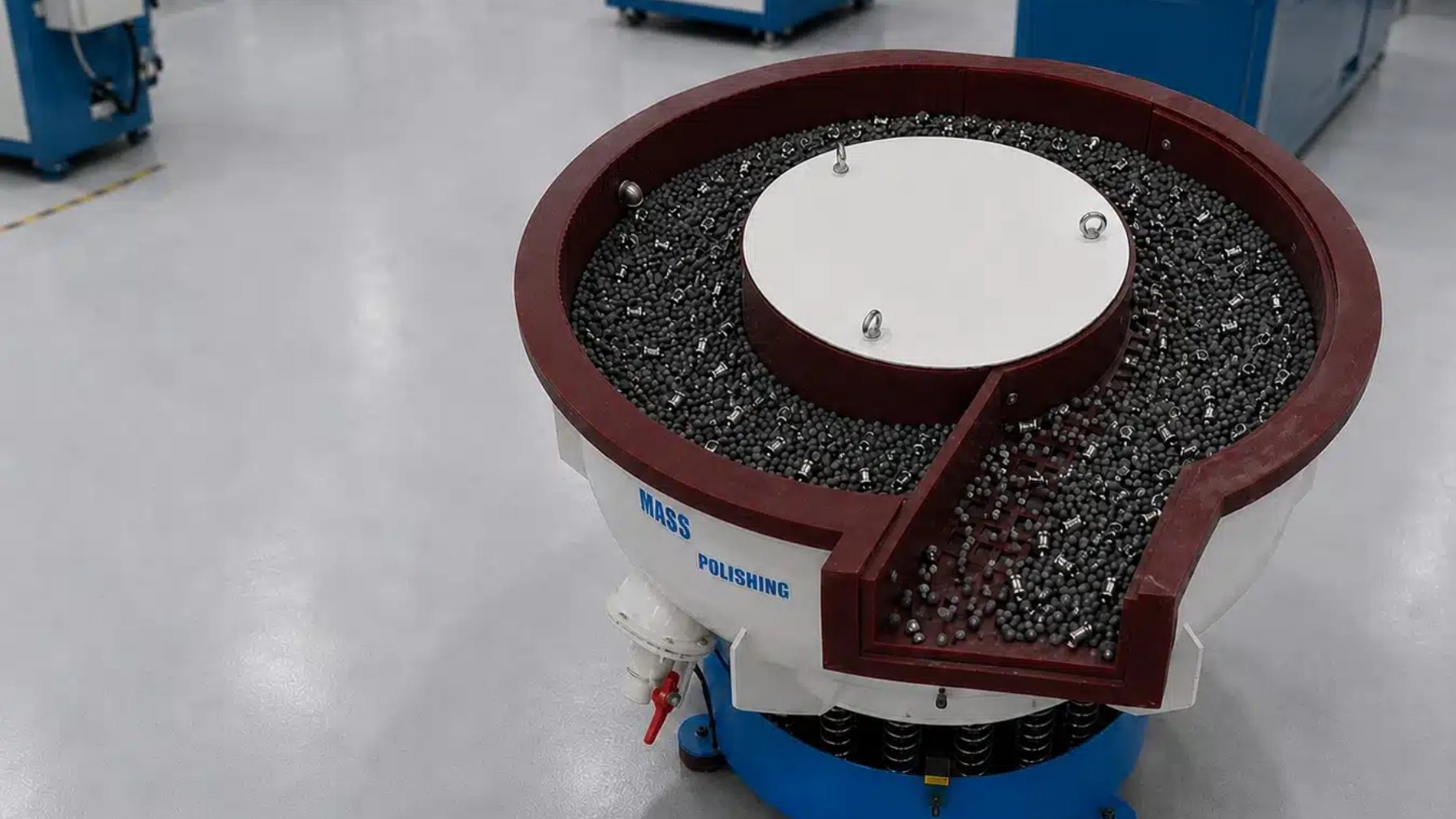
Media is where most watch band polishing problems first appear. Angular ceramic shapes cut fast but can leave a coarse surface if they are too large for the link opening. Small zirconia or porcelain shapes produce a smoother pre-plate finish and hold their geometry longer, but they work slower than standard ceramic. We usually run a two-step sequence: a ceramic cut step for deburring and edge rounding, then a fine porcelain or zirconia step for surface refinement before plating or PVD. That split keeps stock removal in the first step and brightness in the second.
For thin links that nest or lock during watch band polishing, <2023 Hot Selling Parts Finishing Media Anti Adhesion Beads in Mass Polishing> covers how anti-adhesion media keeps small parts separated and improves access to inner link surfaces.
Compound choice is tied to the metal. A degreasing compound works when the priority is cleaning and light finishing, while a polishing compound should be paired with the fine step to carry abrasive action and keep the surface wet. If the band has fine link spacing, anti-adhesion beads prevent links from stacking and starving the inner surfaces. That detail is easy to miss until a batch comes out with bright exteriors and dull interiors.
Machine Comparison for Watch Band Polishing
The machine sets the energy level and the risk of contact damage. Acabado vibratorio is the default for watch band polishing volume because it handles large batches, runs unattended, and gives even contact when the bowl is loaded correctly. Centrifugal disc machines use higher energy and reduce cycle time, but the process window is narrower for delicate bands. Acabado de arrastre removes part-on-part contact and is the right choice when mirror finish or high-precision edge rounding matters more than throughput.
Máquina – Desbarbado de Precisión)
| Proceso | Best use | Typical cycle | Watch band control points |
|---|---|---|---|
| Cuba vibratoria | High-volume batch finishing | 20 to 45 min | Media size, fill level, compound flow |
| Disco centrífugo | Fast edge rounding, pre-plate surface | 8 to 15 min | Speed ramp, gap adjustment, media ratio |
| Acabado de arrastre | Fixtured mirror finish, no part contact | 5 to 15 min | Fixture design, media depth, part orientation |
When watch band volumes are lower and the band needs more energy than vibratory finishing but less part-to-part contact than open disc processing, <What Are the Characteristics of a Acabado en barril centrífugo Página de máquinas> covers barrel geometry and finishing characteristics that transfer well to small precision components.
Process Controls for Consistent Watch Band Polishing
The difference between a sample and production is recorded control, not operator memory. Fill level, media-to-part ratio, compound concentration, water flow, and cycle time all have to stay inside the same range load after load. For watch band polishing we set the media level so the upper surface of the load moves as one mass rather than surging. A common failure is running the bowl too full: the media still moves, but the inner link faces do not see enough contact. A VFD is useful when a separation step follows the finishing step; reducing speed on SWS or CWS models makes parts and media separate cleanly instead of leaving fine media trapped in clasp areas.
– Parts Separation Process)
Inspection also has to be defined. Before approving a batch, check the same three locations on the same number of bands every time: outer link face, inner link edge, and clasp side. A uniform satin band will show consistent reflection across those zones. If plating is the next step, hold a pre-plate roughness check rather than judging only by eye, because microscopic surface variation shows through plating even when the band looks bright.
If your program involves removable links or mixed clasp components, it is worth confirming media size and anti-adhesion load before finalizing the BOM. Send your band drawings and current surface spec to [email protected] and our engineers can check the recipe against your tolerance requirements.
When the first step is aggressive edge rounding on stamped or laser-cut links, <The Benefits of a Vibratory Deburring Machine> covers how vibratory action removes burrs and softens edges while keeping batch sizes acceptable.
Production Specification for Repeatable Watch Band Polishing
After the trial, convert the watch band polishing process into a one-page specification. The sheet should list alloy, pre-finish condition, media code and size, compound ratio, water settings, machine model, speed, load weight, cycle time, and the acceptance criteria. We keep a reference part or photo from the approved batch. That reference does more for consistency than any written description because it gives operators a visual pass/fail standard when the line is running.
Finishing problems stop being expensive when the process stops changing. If you are trying to hold a uniform pre-plate finish on stainless, titanium, or plated watch bands across large batches, send your part number, material, and current surface requirement to [email protected] or call our office at +86 572 211 5098. We will use your band sample to confirm a media-to-part load and machine setting before you commit to production tooling.
cURL Too many subrequests by single Worker invocation. To configure this limit, refer to https://developers.cloudflare.com/workers/wrangler/configuration/#limits
cURL Too many subrequests by single Worker invocation. To configure this limit, refer to https://developers.cloudflare.com/workers/wrangler/configuration/#limits
cURL Too many subrequests by single Worker invocation. To configure this limit, refer to https://developers.cloudflare.com/workers/wrangler/configuration/#limits.
cURL Too many subrequests by single Worker invocation. To configure this limit, refer to https://developers.cloudflare.com/workers/wrangler/configuration/#limits
cURL Too many subrequests by single Worker invocation. To configure this limit, refer to https://developers.cloudflare.com/workers/wrangler/configuration/#limits.
cURL Too many subrequests by single Worker invocation. To configure this limit, refer to https://developers.cloudflare.com/workers/wrangler/configuration/#limits
cURL Too many subrequests by single Worker invocation. To configure this limit, refer to https://developers.cloudflare.com/workers/wrangler/configuration/#limits.
cURL Too many subrequests by single Worker invocation. To configure this limit, refer to https://developers.cloudflare.com/workers/wrangler/configuration/#limits
cURL Too many subrequests by single Worker invocation. To configure this limit, refer to https://developers.cloudflare.com/workers/wrangler/configuration/#limits.
Si está interesado, consulte estos artículos relacionados:
cURL Too many subrequests by single Worker invocation. To configure this limit, refer to https://developers.cloudflare.com/workers/wrangler/configuration/#limits
cURL Too many subrequests by single Worker invocation. To configure this limit, refer to https://developers.cloudflare.com/workers/wrangler/configuration/#limits
How to Operate the Polishing Machine Correctly