
Edge breaking is often treated as a simple deburring step, but when a drawing specifies a controlled edge radius, the requirement is closer to a dimensional process than a cleaning operation. The difference between a sharp, inconsistent edge and a repeatable 0.15 mm radius is rarely the cutting tool. It is the finishing method, the media selection, and how tightly the process variables are held from batch to batch.
For machined parts, consistent radius control matters because edges affect assembly, sealing, coating adhesion, stress distribution, and operator safety. A part that meets every dimensional tolerance can still be rejected because the edge condition is outside the envelope defined by the drawing note. Under ISO 13715, edges of undefined shape can be specified with symbolic indications that define allowable edge condition and size [1]. When the edge is controlled dimensionally, the notation is typically integrated into the geometric dimensioning and tolerancing scheme per ASME Y14.5 [2].
Why Edge Breaking Is a Process Control Problem
A burr can be removed without creating a controlled radius, and a radius can be generated without producing the same radius on every edge. That is the central challenge. Manual deburring reliably removes visible burrs, but it rarely produces a consistent radius because tool angle, hand pressure, and operator technique change throughout a shift.
Mass finishing approaches the edge differently. Instead of cutting only the burr, the workpiece moves through a media bed that contacts all exposed edges at once. The result is a radius that emerges from cumulative abrasion rather than from a single tool pass. This is why vibratory, centrifugal, and finition par dragage are effective for edge breaking: they generate the radius progressively, and the process can be repeated when the media, load, speed, and compound are controlled.
The risk is that “progressive” can also mean “uncontrolled” if the process window is too wide. Edge radius consistency is not guaranteed by machine type alone. It is produced by understanding how much material removal is occurring, where it is occurring, and how those two factors shift as the media wears.
What Consistent Radius Control Actually Means
A consistent edge radius is not a single measured value. It is a distribution. A process may produce an average radius of 0.20 mm but still fail if one edge measures 0.08 mm and another measures 0.35 mm. For that reason, edge control should be defined the same way as other dimensional characteristics: target value, allowable variation, and measurement location.
The specification may come from an edge symbol on the drawing, a profile tolerance, or a general note such as “break all sharp edges R0.10–R0.25.” ISO 13715 provides the vocabulary and indication rules for these undefined edges [1]. When the edge has a functional role in assembly, ASME Y14.5 allows the requirement to be tied to datums and profile tolerance zones so the edge is controlled in relation to other features [2].
Surface texture is also part of the edge condition. The edge radius sits at the transition between two machined surfaces, and its finish affects how coatings wet the corner, how lubricant is retained, and how stress concentrates under load. Surface texture parameters and evaluation methods are defined in ASME B46.1 and ISO 21920-2 [3][4]. A controlled edge radius is therefore not only a geometry target; it is a combined geometry and surface finish requirement.
Methods for Edge Breaking and Radius Generation
The right method depends on part geometry, material, batch size, and how tight the edge tolerance must be.
Manual edge breaking is flexible and low in equipment cost, but it is the most difficult to validate for consistent radius control because the process relies on operator consistency. It is best reserved for very low volume or for touching up isolated edges before final finishing.
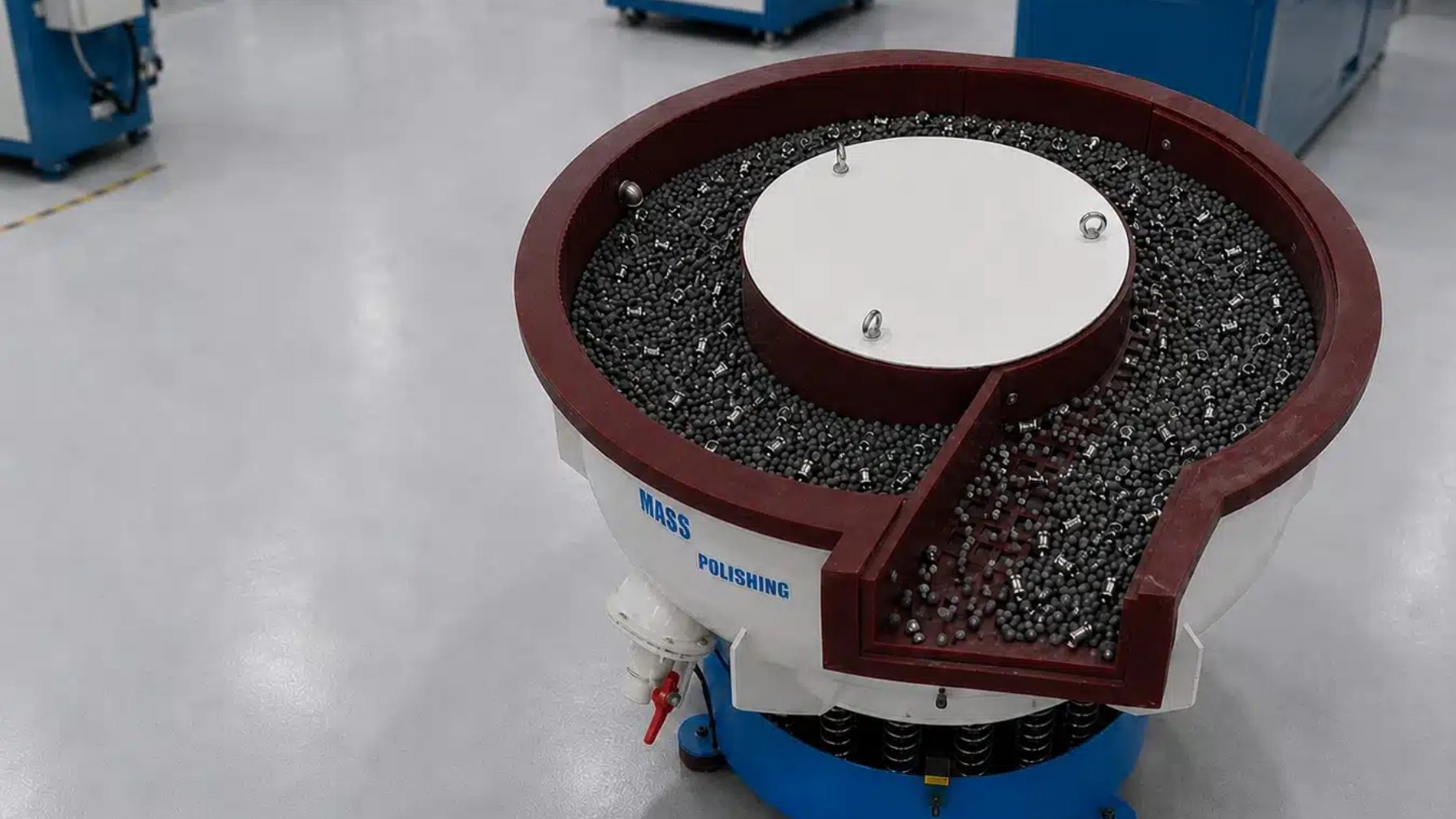
Finition par vibration is a practical first choice for many machined parts. It deburrs, cleans, and smooths edges in bulk, and it can generate a controlled radius when ceramic or plastic media are matched to the material. Loading ratio, water flow, and compound concentration determine how uniformly the radius develops. Because the process is batch-based, part-to-part consistency within a batch is normally good when the load is well controlled.
Finition par disque centrifuge applies higher energy than conventional vibratory finishing and is useful for tougher materials or parts that need faster edge development. The higher force reduces cycle time and can create a more distinct radius, but it also demands closer attention to media size so that holes and recesses are not over-finished.
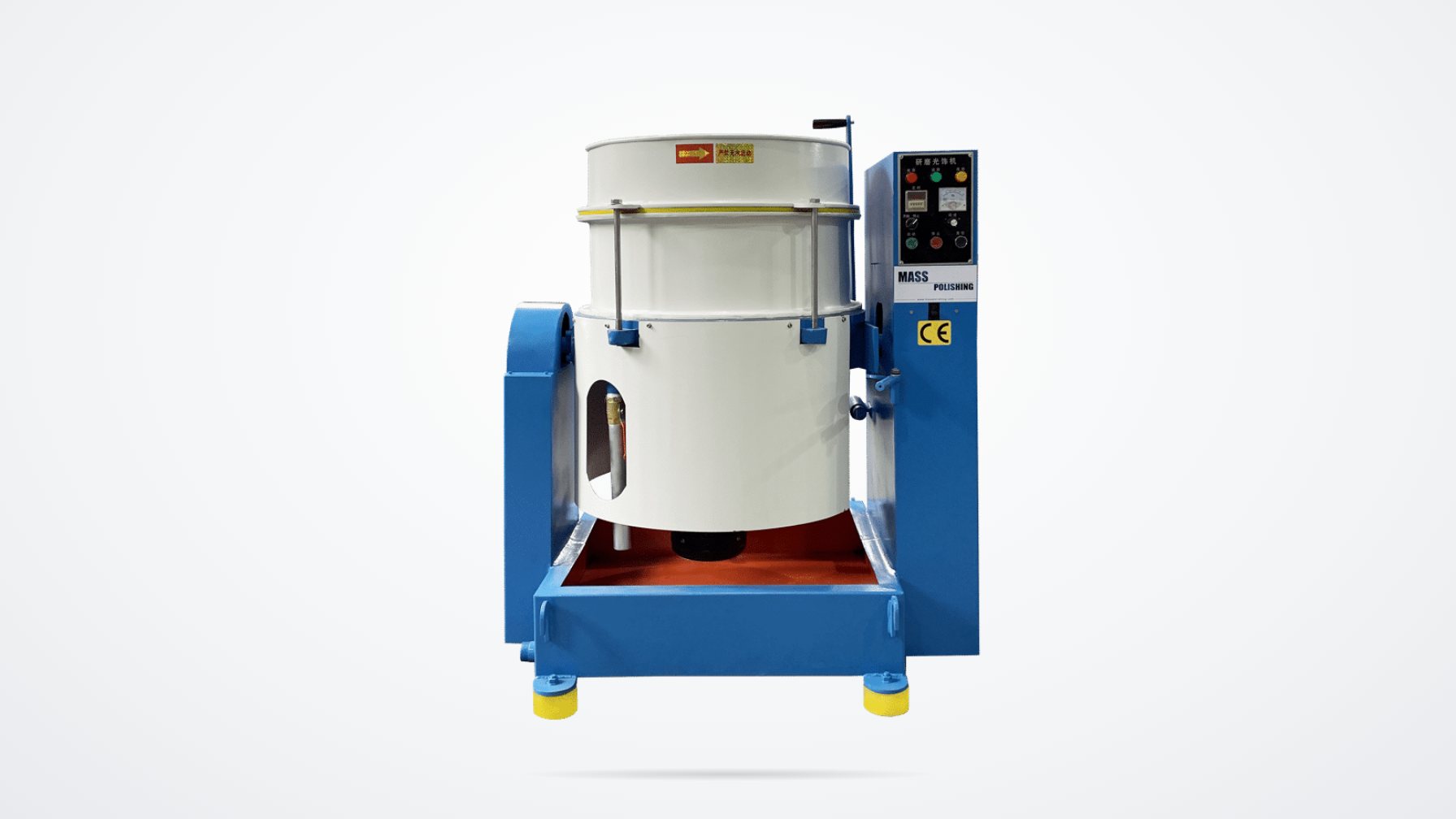
Finissage par baril centrifuge offers high G-forces in a compact envelope and is well suited to small precision machined components. It produces rapid radius generation with good uniformity when barrels are loaded consistently.
Finition par abrasion clamps workpieces and drags them through a media bed. This protects edges that should not be contacted and allows selective edge treatment. It is the preferred method when the part has critical tolerances, fine details, or a requirement to preserve sharp adjacent features while breaking selected edges.
Key Process Variables for Repeatable Edge Radius
Edge radius is not a machine setting; it is the outcome of several interacting variables. The four that have the greatest effect on repeatability are media condition, load geometry, time, and fluid management.
Media shape and size determine where contact occurs. Large, aggressive ceramic shapes cut quickly and produce a broader radius, while smaller or finer media refine the radius and improve surface finish. If the media is too large for holes or slots, it may not reach internal edges or may lodge in the part. If it is too small, edge development slows and the process becomes finish-dominated rather than radius-dominated.
Loading ratio and part orientation control how much energy reaches each edge. An overcrowded bowl slows media movement and produces uneven contact. Too low a load increases part-on-part contact and can cause nicks or excessive edge rounding on exposed surfaces. The same principle applies to centrifugal disc and barrel systems, where chamber fill level and weight distribution must be repeated for every cycle.
Cycle time is the most visible variable, but it is only reliable when the other inputs are stable. A 30-minute cycle that produces R0.15 today will not produce the same radius next week if the media has worn, the compound concentration has drifted, or the incoming burr condition has changed. Time should be treated as a final trim variable, not as the primary control mechanism.
Water and compound flow affect cutting speed, cleaning, and foam generation. Poor wetting reduces abrasive action, while excessive water can dilute the compound and slow the process. Stable flow is essential for a repeatable edge radius, especially in high-volume finishing cells.
Machine – High Energy Deburring)
Getting a stable edge radius depends on repeatable load, water, and compound control. <Comment utiliser une machine de finition vibratoire> covers operating parameters and daily setup routines.
When radius variation appears only on some edges, the cause is usually equipment condition, media loading, or compound flow. <Problèmes courants et contre-mesures des équipements de machines de polissage> covers troubleshooting for vibratory and disc finishing lines.
Pre-finishing surface condition directly affects how uniformly an edge radius develops. <Pourquoi la surface des produits métalliques doit-elle être lisséecURL Too many subrequests by single Worker invocation. To configure this limit, refer to https://developers.cloudflare.com/workers/wrangler/configuration/#limits.
cURL Too many subrequests by single Worker invocation. To configure this limit, refer to https://developers.cloudflare.com/workers/wrangler/configuration/#limits
cURL Too many subrequests by single Worker invocation. To configure this limit, refer to https://developers.cloudflare.com/workers/wrangler/configuration/#limits.
cURL Too many subrequests by single Worker invocation. To configure this limit, refer to https://developers.cloudflare.com/workers/wrangler/configuration/#limits, Finition Vibratoire cURL Too many subrequests by single Worker invocation. To configure this limit, refer to https://developers.cloudflare.com/workers/wrangler/configuration/#limits, Finition par Disque Centrifuge cURL Too many subrequests by single Worker invocation. To configure this limit, refer to https://developers.cloudflare.com/workers/wrangler/configuration/#limits.
cURL Too many subrequests by single Worker invocation. To configure this limit, refer to https://developers.cloudflare.com/workers/wrangler/configuration/#limits, Finition par Baril Centrifuge cURL Too many subrequests by single Worker invocation. To configure this limit, refer to https://developers.cloudflare.com/workers/wrangler/configuration/#limits, Finition par Drag cURL Too many subrequests by single Worker invocation. To configure this limit, refer to https://developers.cloudflare.com/workers/wrangler/configuration/#limits.
cURL Too many subrequests by single Worker invocation. To configure this limit, refer to https://developers.cloudflare.com/workers/wrangler/configuration/#limits.
cURL Too many subrequests by single Worker invocation. To configure this limit, refer to https://developers.cloudflare.com/workers/wrangler/configuration/#limits.
cURL Too many subrequests by single Worker invocation. To configure this limit, refer to https://developers.cloudflare.com/workers/wrangler/configuration/#limits
cURL Too many subrequests by single Worker invocation. To configure this limit, refer to https://developers.cloudflare.com/workers/wrangler/configuration/#limits.
– Parts Separation Process)
cURL Too many subrequests by single Worker invocation. To configure this limit, refer to https://developers.cloudflare.com/workers/wrangler/configuration/#limits.
cURL Too many subrequests by single Worker invocation. To configure this limit, refer to https://developers.cloudflare.com/workers/wrangler/configuration/#limits.
cURL Too many subrequests by single Worker invocation. To configure this limit, refer to https://developers.cloudflare.com/workers/wrangler/configuration/#limits.
cURL Too many subrequests by single Worker invocation. To configure this limit, refer to https://developers.cloudflare.com/workers/wrangler/configuration/#limits. cURL Too many subrequests by single Worker invocation. To configure this limit, refer to https://developers.cloudflare.com/workers/wrangler/configuration/#limits.
cURL Too many subrequests by single Worker invocation. To configure this limit, refer to https://developers.cloudflare.com/workers/wrangler/configuration/#limits
cURL Too many subrequests by single Worker invocation. To configure this limit, refer to https://developers.cloudflare.com/workers/wrangler/configuration/#limits. cURL Too many subrequests by single Worker invocation. To configure this limit, refer to https://developers.cloudflare.com/workers/wrangler/configuration/#limits.
cURL Too many subrequests by single Worker invocation. To configure this limit, refer to https://developers.cloudflare.com/workers/wrangler/configuration/#limits. cURL Too many subrequests by single Worker invocation. To configure this limit, refer to https://developers.cloudflare.com/workers/wrangler/configuration/#limits.
cURL Too many subrequests by single Worker invocation. To configure this limit, refer to https://developers.cloudflare.com/workers/wrangler/configuration/#limits. cURL Too many subrequests by single Worker invocation. To configure this limit, refer to https://developers.cloudflare.com/workers/wrangler/configuration/#limits.
cURL Too many subrequests by single Worker invocation. To configure this limit, refer to https://developers.cloudflare.com/workers/wrangler/configuration/#limits. cURL Too many subrequests by single Worker invocation. To configure this limit, refer to https://developers.cloudflare.com/workers/wrangler/configuration/#limits.
cURL Too many subrequests by single Worker invocation. To configure this limit, refer to https://developers.cloudflare.com/workers/wrangler/configuration/#limits. cURL Too many subrequests by single Worker invocation. To configure this limit, refer to https://developers.cloudflare.com/workers/wrangler/configuration/#limits.
cURL Too many subrequests by single Worker invocation. To configure this limit, refer to https://developers.cloudflare.com/workers/wrangler/configuration/#limits. cURL Too many subrequests by single Worker invocation. To configure this limit, refer to https://developers.cloudflare.com/workers/wrangler/configuration/#limits.
cURL Too many subrequests by single Worker invocation. To configure this limit, refer to https://developers.cloudflare.com/workers/wrangler/configuration/#limits
cURL Too many subrequests by single Worker invocation. To configure this limit, refer to https://developers.cloudflare.com/workers/wrangler/configuration/#limits.
cURL Too many subrequests by single Worker invocation. To configure this limit, refer to https://developers.cloudflare.com/workers/wrangler/configuration/#limits.
Questions Fréquemment Posées
cURL Too many subrequests by single Worker invocation. To configure this limit, refer to https://developers.cloudflare.com/workers/wrangler/configuration/#limits
cURL Too many subrequests by single Worker invocation. To configure this limit, refer to https://developers.cloudflare.com/workers/wrangler/configuration/#limits.
cURL Too many subrequests by single Worker invocation. To configure this limit, refer to https://developers.cloudflare.com/workers/wrangler/configuration/#limits
cURL Too many subrequests by single Worker invocation. To configure this limit, refer to https://developers.cloudflare.com/workers/wrangler/configuration/#limits.
cURL Too many subrequests by single Worker invocation. To configure this limit, refer to https://developers.cloudflare.com/workers/wrangler/configuration/#limits
cURL Too many subrequests by single Worker invocation. To configure this limit, refer to https://developers.cloudflare.com/workers/wrangler/configuration/#limits.
cURL Too many subrequests by single Worker invocation. To configure this limit, refer to https://developers.cloudflare.com/workers/wrangler/configuration/#limits
cURL Too many subrequests by single Worker invocation. To configure this limit, refer to https://developers.cloudflare.com/workers/wrangler/configuration/#limits.
cURL Too many subrequests by single Worker invocation. To configure this limit, refer to https://developers.cloudflare.com/workers/wrangler/configuration/#limits
cURL Too many subrequests by single Worker invocation. To configure this limit, refer to https://developers.cloudflare.com/workers/wrangler/configuration/#limits.
cURL Too many subrequests by single Worker invocation. To configure this limit, refer to https://developers.cloudflare.com/workers/wrangler/configuration/#limits
[1] International Organization for Standardization. ISO 13715:2017, Technical product documentation — Edges of undefined shape — Vocabulary and indications. ISO, Geneva, 2017.
[2] American Society of Mechanical Engineers. ASME Y14.5-2018, Dimensioning and Tolerancing (GD&T). ASME, New York, 2018.
[3] American Society of Mechanical Engineers. ASME B46.1-2019, Surface Texture (Surface Roughness, Waviness, and Lay). ASME, New York, 2019.
[4] International Organization for Standardization. ISO 21920-2:2021, Geometrical product specifications (GPS) — Surface texture: Profile method — Part 2: Terms, definitions and surface texture parameters. ISO, Geneva, 2021.
Si vous êtes intéressé, consultez ces articles liés :
Industrie de la bijouterie
cURL Too many subrequests by single Worker invocation. To configure this limit, refer to https://developers.cloudflare.com/workers/wrangler/configuration/#limits
cURL Too many subrequests by single Worker invocation. To configure this limit, refer to https://developers.cloudflare.com/workers/wrangler/configuration/#limits